Nation's Report Card shows further decline in literacy, GOP Rep Owens says system 'failing' students
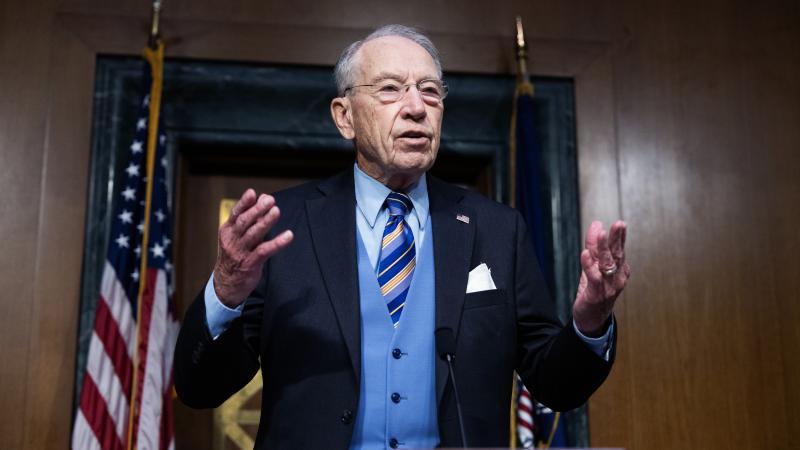
Owens, a Utah GOP congressmen, is a member of the House Education committee and is a strong advocate for school choice.
Student achievement is on the decline nationwide, particularly in the ability to read, write and comprehend text, according to the most recent Nation’s Report Card.
Beyond the overall decline, educators, lawmakers and others are particularly concerned about the incongruence of Black and Hispanic students consistently having lower test scores, compared to their White and Asian counterparts, while their graduation rates and grade point averages, or GPAs, continue to climb.
Experts say the disparity might be explained by so-called "equitable grading" practices, in which the report cards of "historically disadvantaged" students appear inflated – giving the illusion that they are meeting critical education benchmarks.
According to a Fordham Institute survey, roughly half of teachers have adopted at least one "equitable grading" practice, most commonly reported in urban, majority minority school districts, such as "No Zero" policies, no late penalties and unlimited retakes.
“These ideologies promise to liberate oppressed minorities, but the data doesn't lie. The Nation's Report Card shows the decline. And in a cruel twist, the students who are supposed to benefit the most from these woke agendas are hurt the most by them," Utah GOP Rep. Burgess Owens, a member of the House Education committee, said recently in an exclusive interview with Just the News.
“It’s not the fault of the students,” he also said. “The system is failing them.”
Owens, a champion for legislation such as the Educational Choice for Children Act, says the solution is more "school choice.”
“Every child, regardless of race, income, or zip code, deserves access to a school that works for them, not one assigned by government bureaucrats," he said. "Parents know their children and know how they learn best, and they should not be forced to remain in a failing school district simply because of their zip code.”
At roughly the same time the data was collected for the Report Card, Black and Hispanic graduation rates are increasing nationwide, by roughly 10% and 14% from 2011-2012 and 2021-2022, respectively.
Owens, who said the situation – and his understanding of it, based in part on having grown up in the "Jim Crow Segregated South" – should “sound alarm bells to every parent in America.”
“We are not witnessing a miracle. Instead, we're witnessing social promotion," he said of the seemingly inflated numbers. "A diploma should be a ticket to opportunity, not a false promise handed out by schools more focused on ideology than instruction.”
The report card, otherwise known as the National Assessment of Educational Progress (NAEP), put out by the National Center for Education Statistics, shows overall that 40% of fourth-graders and about 33% of eighth and twelfth-graders are performing at the lowest level – “Below Basic Proficiency” – in reading. In other words, they struggle to comprehend simple texts, determine the meaning of common words and use context clues to draw basic conclusions.
Atlanta and Chicago – where roughly 80% of the public school population is Black and Hispanic – are among those with the worst reports.
Just 15% of Chicago Public Schools high school students can read proficiently, yet the district reports a 75.8% graduation rate. In Atlanta, only 27% meet proficiency, yet over 90% of students graduated on-time in 2025.
“The fact that graduation rates continue to rise is not surprising because it's a completely bogus metric in an age of social promotion and lack of enforced standards,” said Defending Education’s Erika Sanzi. “We lie to students about their preparedness by giving them a diploma and then take zero responsibility for the consequences of that deception.”
Education policy experts say the solution can be found in keeping academic standards high, prioritizing proven literacy instruction, and universal school choice.
“The achievement gap is proof that public education needs to change,” said Defense of Freedom Institute spokeswoman Angela Morabito.
“Union bosses enjoy the most power over schools in the big blue cities, where they purposefully prevent families – many of them Black and Hispanic – from exercising school choice. Meanwhile, all the billions spent on so-called equity and gender ideology hasn't helped students to learn to read, write and think.”
When Houston Independent School District Superintendent Mike Miles prioritized rigorous academic instruction and "science of reading" rather than DEI ideology, state assessments showed literacy gains among Black and Hispanic third-grade students of 3% and 5%, respectively, between the 2022-23 and 2023-24 school years.
Paul G. Vallas, former superintendent of New Orleans Recovery School District (RSD), attributes Louisiana’s recent success to school choice and high academic standards.
In the high-poverty, Black and Hispanic-majority city, New Orleans, 61% of the city's schools in 2005 were reported “failing.” After Hurricane Katrina, the city was forced to rebuild its school system from the ground up.
The extenuating circumstances allowed for more flexibility, and, using a charter system, schools became more independent, free of bureaucracy and union influence. Taxpayer education dollars followed students, empowering parents with choice and forcing schools to compete for families.
"Schools had to attract families, keep them, and show results," Vallas recently wrote in City Journal.
The district also resisted ‘equitable grading’ policies, instead “raising standards and steadily increasing proficiency cut scores on state tests.”
Louisiana currently reports no failing schools, and was the only state in 2024 to outperform its pre-pandemic (2019) literacy, rising from 50th to 16th in the nation in 4th grade reading scores.
The Facts Inside Our Reporter's Notebook


Top Stories




Trending
Just the News Spotlight
Just News, No Noise